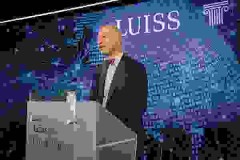
Franco Pomilio Blumm: 'With Art and Ethics, We Research New Perspectives on AI for the Communication of Big Institutions'
A continuous dialogue with technology to create new narratives and promote inclusivity. This was the powerful message delivered by Stephanie Dinkins, a transdisciplinary artist, at the Oscar Pomilio Blumm Forum in Pescara, where she received the Ethic Award for her contributions. 'Artificial Intelligence (AI) holds immense promise, yet it is also fraught with challenges that we must confront with urgency and care. AI is not a monolithic entity; it is shaped by those who create and train it. This means that our diverse perspectives and stories need to be at the forefront of AI development to ensure it serves all of humanity equitably. At this moment, we have the unique opportunity to reimagine our relationship with technology. By integrating community knowledge and culturally specific data into AI, we can develop systems that are more inclusive and supportive of all people. AI should not just be about efficiency and profit; it should be about fostering mutual respect, responsibility, and care across as many global communities as possible.'
Dinkins is a pioneer in combining art and technology, Kusama Professor of Art at Stony Brook University New York and Inaugural recipient LG-Guggenheim Award 2023. She is recognized by Time magazine as one of the world's most influential innovators in AI. Her Art and AI project began with a provocative question: Can an artist and a social robot build a relationship over time?
'My work, for example, explores how we can use AI to tell our own stories and create new narratives that reflect our true experiences and aspirations. It's about finding ways to bend and nurture technology to serve our needs and support our communities. The future of AI, therefore, lies in our hands—in our belief that we can demand and create systems that are just, transparent, and accountable. This perspective underscores the need for broad participation in AI development and the importance of creating technology that genuinely reflects and serves the diversity of human experiences.'
Stephanie Dinkins received the Ethic Award from the Oscar Pomilio Blumm Forum for her 'groundbreaking work at the intersection of AI and social equity. As a pioneering artist and educator, she has explored the ethical implications of AI with a particular focus on marginalized communities,' as stated in the award's rationale.
The Forum was interesting for the different angles it showed regarding artificial intelligence: art and journalism, represented by Alejandro Tauber, publisher of the EUobserver, an independent news media outlet, one of the most relevant in European Union politics. The Forum was opened by Franco Pomilio, president of Pomilio Blumm, a communication agency dealing with international public institutions. 'We have initiated a very interesting dialogue on artificial intelligence with two exceptional speakers, Stephanie Dinkins and Alejandro Tauber,' said Franco Pomilio, 'and this is part of our future strategy in new technologies and new languages. In September we will complete the first phase of this cultural growth, with the AI and Ethics expert Father Paolo Benanti speaking at our Summer University 2024 on EU Institutional Communication, developed with the involvement of Maastricht University. Those initiatives are the beginning of a path towards the creation of an AI development hub in Pescara.'
Adding richness to the audience's vision was the perspective of Alejandro Tauber, considered an expert on technology and artificial intelligence: 'AI is an averaging machine, a machine of average responses, not particularly brilliant,' explained Tauber during his speech. 'This shows its limitations, and while we understand AI's dependence on data aggregation and pattern recognition, we can better appreciate its strengths. Recognizing AI as an averaging machine also underscores the importance of human oversight and ethical considerations in its implementation in the media world.' Alejandro Tauber was honored with the Ethic Journalism Award for his outstanding contributions to ethical journalism.
Attachment
- Stephanie Dinkins Awarded the Ethic Award, Oscar Pomilio Forum