

NEW YORK, June 16, 2026 (GLOBE NEWSWIRE) -- Smart Communications™, a leading customer engagement technology provider for regulated industries, today released its 2026 Customer Experience Benchmark research findings, the most comprehensive edition of the annual study to date.
This year’s findings leave no room for doubt: how brands communicate can make or break your business. Two in every three consumers (63%) say they would switch providers if communications failed to meet their expectations, rising to 72% among Millennials and 70% among Gen Z.
Drawing on responses from 4,000 consumers worldwide across the financial services, insurance, healthcare, and government sectors, the research exposes the brutal cost of getting customer communications wrong.
Expectations for engagement hit an all-time high, but satisfaction is dipping
Eight in ten (85%) of consumers say communications directly impact how they feel about their favorite brand, an all-time high since the study’s inception. The stakes are equally high across every sector surveyed: financial services (85%), insurance (86%), healthcare (86%), and government (87%) customers say communications directly shape their experience.
But importance and satisfaction are moving in opposite directions. Only 52% rate their current communications as good or excellent, a 10-point decrease year-on-year, with the sharpest decline in insurance, where satisfaction has fallen to just 50%. Roughly two in five customers across all industries and markets do not consider the communications they receive to be good, an early sign of what’s to come.
The culprits are consistent across all markets and generations: poorly written communications, broken form processes, and AI deployed without the transparency or human oversight that customers now demand.
AI confidence falls while expectations for governance and human oversight rise
The initial wave of AI optimism is flattening and, in some areas, reversing. Consumer confidence in AI's ability to improve the customer experience has dropped to 56%, down 5 points from last year. Trust in AI to manage personal data securely has fallen 6 points in just twelve months. At the same time, concern about the lack of human control has increased by 4% globally, with Baby Boomers registering a 10% surge in concern in a single year.
The value consumers see in AI for real-life use cases is on a year-on-year decline:
- AI-powered financial advice: valued by 44% - a 2% decrease YoY
- AI-suggested insurance plan changes: valued by 45% - a 6% decrease YoY
- AI health recommendations: valued by 46% - an 8% decrease YoY
Meanwhile, demand for transparency has intensified. Most consumers (82%) worldwide say it’s important for companies to disclose when AI is used in their interactions. This share rises to 88% among Baby Boomers and reaches 90% in countries like Australia. While 44% trust companies to use AI responsibly in ways that benefit them, that figure drops to just 30% among Boomers and trails significantly in the Benelux region (31%) and New Zealand (38%), where trust is at its lowest.
The generational divide offers valuable insight too. Among Gen Z and Millennials, over half (56-57%) trust companies to use AI responsibly, compared with just 3 in 10 Boomers (30%). Similarly, confidence that AI will improve customer experience is highest with Millennials (67%) and Gen Z (65%), but falls to 42% among Boomers. As the demographic with the greatest financial assets today, older consumers represent a segment organizations cannot afford to alienate.
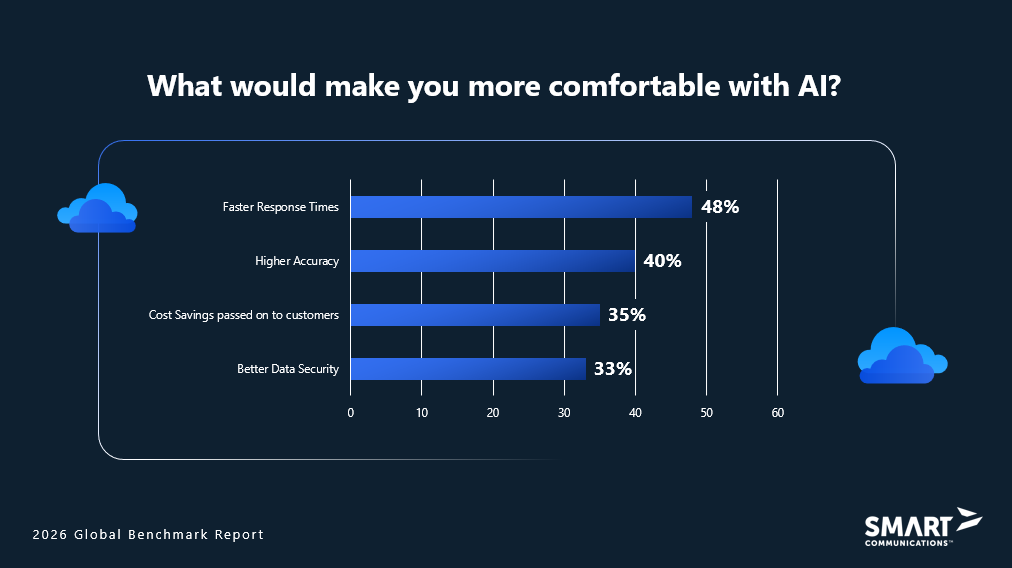
The message to organizations is clear: AI deployment without transparency, human monitoring, and genuine value-add risks eroding the trust you’ve painstakingly built over the years.
The findings carry particular weight for regulated industries, where communication often occurs during critical moments that shape trust and outcomes. In these moments, clarity, trust, and compliance are not separate considerations – they are the customer experience.
Every form failure and data breakdown puts customer trust and loyalty at risk
Data collection and form processes are one of the most consequential yet overlooked battlegrounds in customer experience. Nearly two-thirds of consumers (61%) say they would end a relationship with a company if the data collection process was too difficult. That figure rises to 69% among Millennials and 66% among Gen Z, indicating a lower tolerance for friction and a tendency to quickly abandon brands that get it wrong among younger demographics.
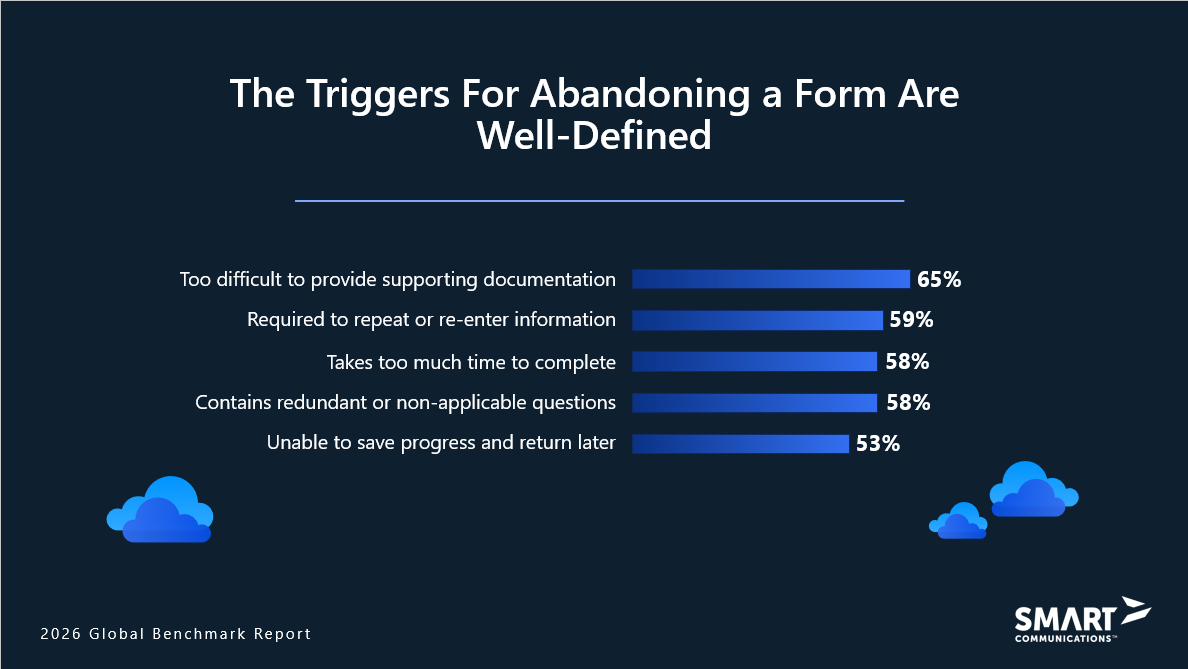
Disconnected systems are at the core of these failures. Half of consumers (48%) say they sometimes or always need to repeat information when switching between channels and representatives, even though 86% say that seamless information carry over across channels is at least somewhat important to them. This gap between expectation and reality is one of the clearest signals of how businesses have been falling short over the past year.
And when these journeys break down, people escalate them to a human most often. The most common reason consumers abandon digital channels and turn to customer service is ‘unclear communication’, cited by 43% of consumers across all age groups, industries, and geographies. For organizations running large contact center operations, this is a measurable and avoidable cost.
But the upside of fixing these issues is equally compelling and marks the largest year-over-year shift across the entire study.
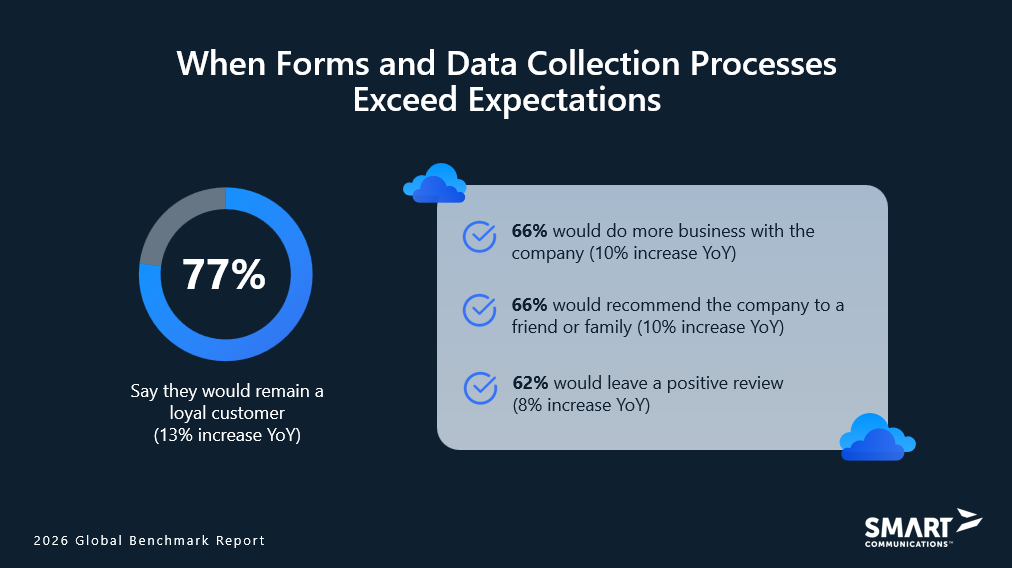
The findings expose a systems problem masquerading as a customer satisfaction problem. The biggest drivers of customer churn aren’t complex; they’re operational, fixable, and often overlooked. Organizations that solve this will not only address the symptomatic downfalls their competitors are ignoring, but they will also see measurable returns.
“This research indicates that organizations are reaching a tipping point,” said Leigh Segall, CEO, Smart Communications. “Customer expectations continue to rise, but many businesses are struggling to keep pace. Consumers are telling us they will switch providers when communications fall short or break down across channels, and they are becoming more selective about how and where they trust AI. For regulated industries, where interactions often involve healthcare decisions, insurance claims, financial guidance, or government services, the stakes couldn’t be higher. The organizations that succeed will be those that simplify complex interactions, apply AI responsibly and transparently, and create experiences that built trust at every step.”
According to Amy Machado, Research Director at IDC, the findings reflect a broader shift in how customers evaluate companies in an increasingly digital environment: “What we’re seeing here is a transition from digital adoption to digital expectation. Customers are no longer impressed by the presence of AI, they’re judging how well it works for them.” She concludes: “The challenge is that many organizations are still trying to meet modern expectations with legacy systems and fragmented processes. The winners will be those that unify customer experiences, apply AI responsibly, and build trust through every interaction.”
Additional findings are available through the company’s new interactive web experience, which includes downloadable charts, detailed industry, regional and demographic analyses, and industry-specific versions of the 2026 Customer Experience Benchmark reports.
Notes for editors
For additional insights, high-res imagery, or to arrange interviews with Smart Communications executives and research leads, please contact the Lorries PR team - SmartCommunications@rlyl.com
Research methodology
The survey was conducted by Toluna on behalf of Smart Communications in June 2026, gathering insights from 4,000 consumers aged 18–55+ across the United States, the United Kingdom, Europe, and APAC, spanning the financial services, insurance, healthcare, and government sectors.
About Smart Communications
Smart Communications is a leading customer engagement technology provider for regulated industries. The company helps organizations simplify the complex interactions that shape people’s lives by enabling more connected, personalized, and trusted customer engagement. Its Customer Engagement Platform brings together data collection, customer communications, journey orchestration, trusted AI, and information management to help organizations create seamless experiences across the customer lifecycle. By connecting the systems, processes, and interactions that drive critical business outcomes, Smart Communications enables organizations to improve customer experience, increase operational efficiency, strengthen compliance, and build trust at every touchpoint. More than 700 enterprises worldwide, including Zurich Insurance, Priority Health, The Pacific Financial Group, and The Bancorp, rely on Smart Communications to power engagement in regulated environments. With more than 30 pre-built integrations to leading enterprise platforms including Salesforce, AWS, Guidewire, Duck Creek, OneSpan, and Pega, Smart Communications powers more than 60 billion mission-critical customer interactions each year.
Photos accompanying this announcement are available at
https://www.globenewswire.com/NewsRoom/AttachmentNg/7ce1fb10-04e7-4941-932a-faa51508464f
https://www.globenewswire.com/NewsRoom/AttachmentNg/8733b437-9e28-4e8e-890c-d8410a851621
https://www.globenewswire.com/NewsRoom/AttachmentNg/3f73e687-6cd4-4aab-a3b4-4f482f1b007c
https://www.globenewswire.com/NewsRoom/AttachmentNg/f27047ce-454d-4610-82a6-a0a20d5d7113