
ULAANBAATAR, Mongolia, Jan. 27, 2026 (GLOBE NEWSWIRE) -- The Government of Mongolia received the National Productivity Master Plan for Mongolia 2026–2035 at the Deputy Prime Minister’s office, Government Palace, Ulaanbaatar, on 26 January 2026. The master plan was formally handed over to the Deputy Prime Minister of Mongolia, H.E. Gankhuyag Khassuuri, by the Asian Productivity Organization (APO) Secretary-General, Dr. Indra Pradana Singawinata, in an official ceremony jointly organized by the Ministry of Family, Labour and Social Protection; the Mongolian Productivity Organization; and the APO.
The master plan provides a national pathway for strengthening competitiveness and resilience by making productivity a deliberate, measurable priority. It presents a clear baseline message: Following a business-as-usual trajectory without significant productivity reforms, annual GDP growth in Mongolia is projected to slow from 6.2% (2000–24) to 4.2% in 2026–35 and then to 2.8% from 2036 to 2050, driven primarily by a decline in the contribution of labor productivity from 4.0% to 1.4% over the same periods.
“The Master Plan is not merely a report. It is a strategic instrument of statecraft,” said Secretary-General Dr. Indra. In addition, he emphasized that productivity, when treated as a deliberate national agenda, can raise living standards, strengthen competitiveness, and widen opportunity simultaneously.
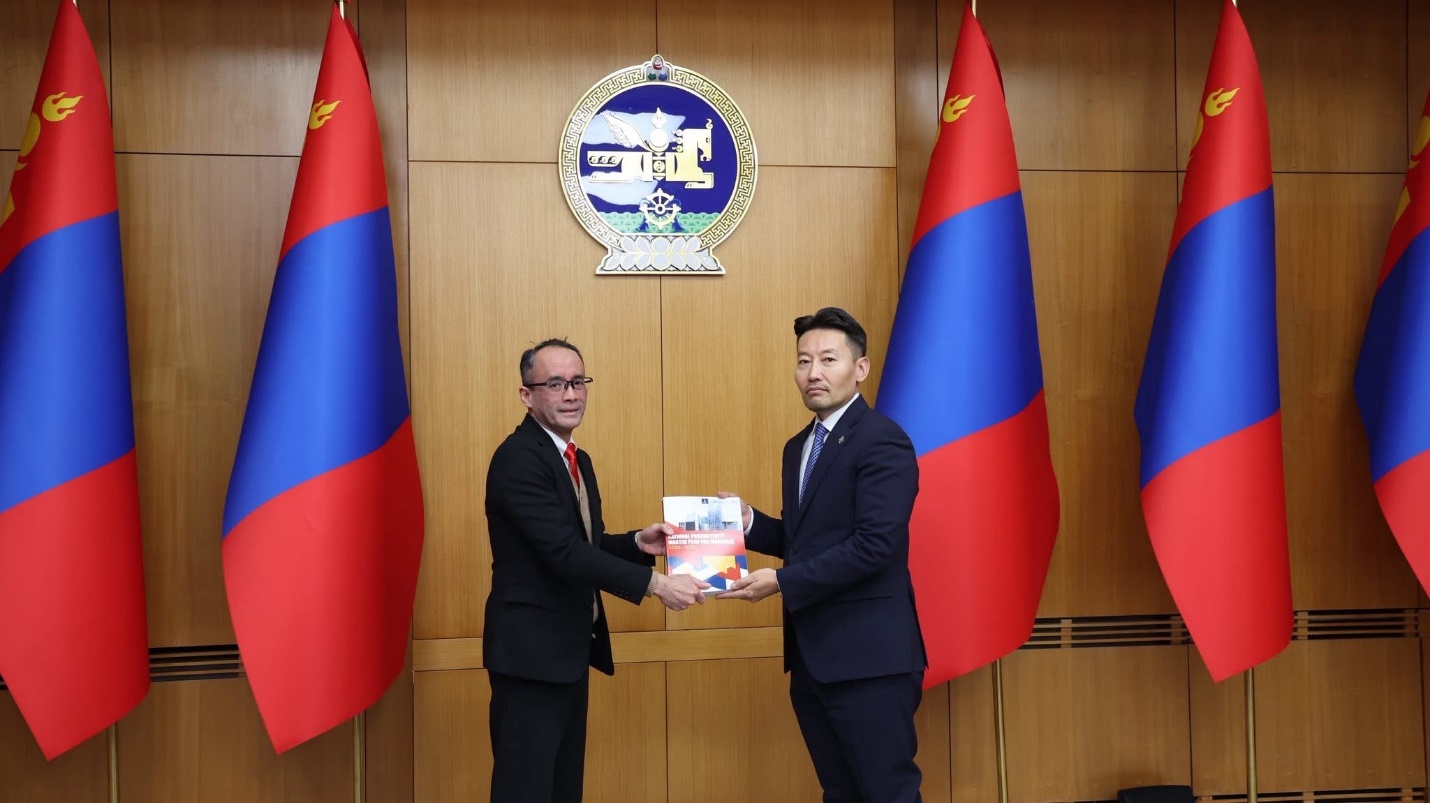
In his remarks, Deputy Prime Minister Gankhuyag reaffirmed the Government’s productivity-led development objectives, including efforts to “increase the labor productivity and wages of Mongolian people” and to sustain stable growth “above 6 percent” through higher manufacturing processing, productivity, and diversification. He also emphasized public sector productivity reforms under the New Revival Policy, including digitalizing public services, reducing bureaucracy, streamlining inspections, and rationalizing special permits, while underscoring that “productivity is not only an economic indicator” but a concept that directly affects public service quality and citizens’ quality of life.
Minister for Family, Labour and Social Protection Aubakir Telukhan highlighted Mongolia’s national policy direction to advance a “Productivity Revolution,” reduce unemployment, and steadily increase labor productivity and wages while aligning reforms with rapid global changes in technology, trade, and climate policy. Highlighting the scale of the challenge, he stated: “In Mongolia, average labor productivity is 11.3 thousand US dollars, which is 3.6 times lower than the global average.”
To address the above, the master plan is structured around five strategic thrusts:
Expanding market access and prospectsDriving technology and digitalizationRaising the quantity and quality of talentMaking an efficient business environmentShaping inclusiveness and equityIt also identifies eight priority sectors for focused productivity acceleration: agriculture, forestry, and fishing; processing industries (manufacturing); wholesale and retail trade (including vehicle repair); education services; accommodation and food services; human health and social work activities; water supply and sewerage, waste management, and remediation; and transportation and storage.
Secretary-General Dr. Indra expressed his appreciation to the Government of Mongolia, the Mongolian Productivity Organization, ministries, and stakeholders for their leadership and substantive contributions. He also reaffirmed the APO’s continued commitment to translating Mongolia’s National Productivity Master Plan into measurable outcomes.
About the APO The Asian Productivity Organization (APO) is a regional intergovernmental organization dedicated to improving productivity in the Asia-Pacific region through mutual cooperation. It is nonpolitical, nonprofit, and nondiscriminatory. Established in 1961 with eight founding members, the APO currently comprises 21 member economies: Bangladesh; Cambodia; the Republic of China; Fiji; Hong Kong; India; Indonesia; Islamic Republic of Iran; Japan; the Republic of Korea; Lao PDR; Malaysia; Mongolia; Nepal; Pakistan; the Philippines; Singapore; Sri Lanka; Thailand; Turkiye; and Vietnam.
The APO is shaping the future of the region by fostering the socioeconomic development of its members through national policy advisory services, acting as a think tank, institutional capacity-building initiatives, and knowledge sharing to increase productivity.
For details, contact the APO Digital Information Unit: pr@apo-tokyo.org.
Website: https://www.apo-tokyo.org
A photo accompanying this announcement is available at https://www.globenewswire.com/NewsRoom/AttachmentNg/42ba291c-06de-464d-b487-74b8445f1b0b