
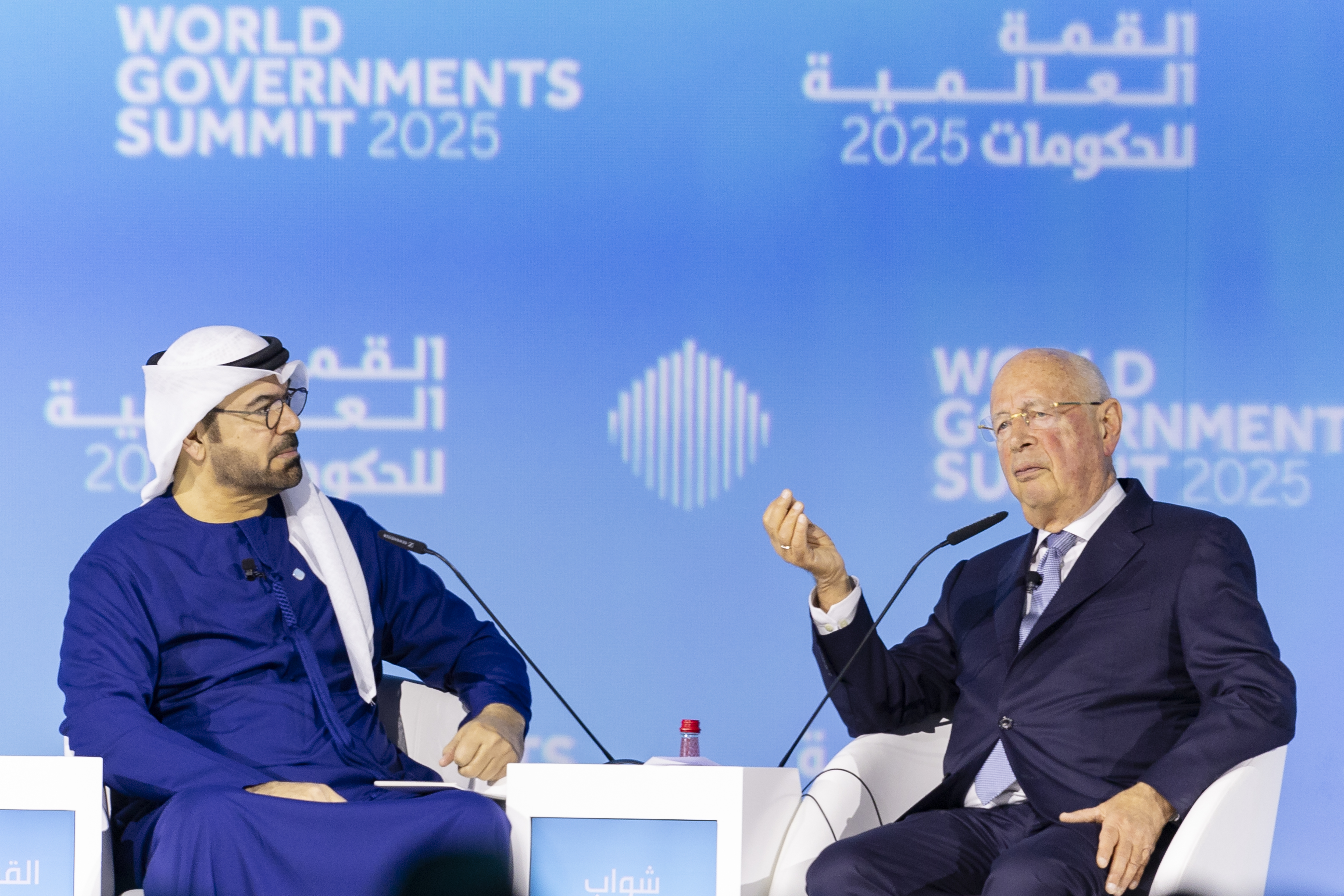
Government and corporate leaders gather at Dubai’s World Governments Summit to chart an innovative roadmap for global governance, focusing on solutions in healthcare, education, technology, international trade, and mobility.
DUBAI, United Arab Emirates, Feb. 12, 2025 (GLOBE NEWSWIRE) -- The 12th edition of the World Governments Summit (WGS 2025) launched on Tuesday in Dubai, bringing together governments, business executives, and thought leaders to address profound transformations in global governance. Led by H.E. Mohammad Abdullah Al Gergawi, UAE Minister of Cabinet Affairs and Chairman of the World Governments Summit, the global platform fosters inclusive dialogue on sustaining our planet and livelihoods—covering climate change, global economic challenges, the redefinition of education and mobility, as well as emerging trends in global trade. The impact of AI, particularly amid competition between China and the U.S., has emerged as a central theme across all discussions at the Summit.
'The past 25 years have been nothing short of extraordinary, marked by major transformations and shifts,' said Gergawi. He noted that the global economic order has shifted from being dominated by industrial giants to one driven by technology firms and digital platforms. “China and India are rising, while some advanced industrial nations have declined. What is coming is a new era - one that will be written with new rules.”
With participation from over 30 heads of state and government - including Gustavo Petro, the President of Colombia; Andrzej Duda, the President of Poland; and Anura Kumara Dissanayake, the President of Sri Lanka - along with 80+ international organizations, 140 government delegations, and more than 6,000 attendees, WGS 2025 will, over the next two days, explore groundbreaking ideas to accelerate global partnerships and redefine leadership in the digital age.
IMF’s Managing Director Kristalina Georgieva highlighted the “remarkable resilience” of the global economy while pointing to two underlying developments. First, diverging economic fortunes, with Gulf economies performing strongly, while Europe and some emerging markets remain vulnerable. Second, disparities in AI adoption, where some nations are leveraging AI as a productivity enhancer, while others struggle to keep pace with these transformative technologies.
When asked about if governments and humans have a good handle on the new technology such as AI and if it was the “tail wagging the dog” she responded the dog was “already barking at us and we better be prepared”. More broadly, she said it was crucial to recognise there was now a “multi-polar world” with some emerging market economies moving forward “much faster” usually because of the three “Ds” – deregulation; digitisation; and diversification.
Business and government in partnership towards innovation
Throughout discussions spanning various industries and regions, the disruptive impact of AI was a recurring theme. The Summit examined AI’s impact on the automotive sector, education, and governance.
Klaus Schwab, Founder and Executive Chairman of the World Economic Forum highlighted that governments have to act as educators and show society how new technology can bring more opportunity. He said: “The future is not happening. The future is shaped by us. The future has to be shaped through cooperation and collaborative efforts between governments, business and civil society.”
Meanwhile, H.E. Omar Sultan Al Olama, UAE Minister of State for Artificial Intelligence, Digital Economy, and Remote Work Applications, and Vice Chair of the World Governments Summit, led discussions on how agentic automation is reshaping the workforce.
“At the Summit, we are focused on developing a proactive approach to the workforce evolution, ensuring that economies remain agile, talent is continuously upskilled, and critical sectors are safeguarded. We want to have an inclusive vision of what AI is going to look like for the world, and also try to bring the voices that are not necessarily in all of the other conversations around the world,” said Olama.
While governments focus on adapting to AI-driven workforce changes, industry leaders emphasize the economic impact of AI advancements, particularly in reducing costs and driving competition.
Arvind Krishna the CEO of IBM comments: “Deepseek is a wake up moment that the trend, which every technology for 70 years has seen is happening. Cost comes down, ability to serve it comes down, competition springs up. The advantage for everybody - much lower cost going forward. For the tech industry, it means that we find ways to develop technology cheaper.”
AI’s impact on global power structures
Beyond its societal implications, the Summit is examining the potential of AI application across verticals, and the need for AI regulation, as well as its limitations.
Mike Sicilla, Executive Vice-President of Oracle, believes healthcare is one of the main areas where AI will see significant developments. He says: “AI is an excellent opportunity for the world governments to work together without requiring to break any privacy and cybersecurity rules. I believe in the next few years there will be an incredible breakthrough in the healthcare sector around the use of applied AI both at the macro level for infectious disease tracking, and also for personalized medicine and vaccines.”
Commenting on developments of AI in Europe, the CEO of SAP, Christian Klein predicts: “LLMs will be more and more commoditized and value creation will happen at the level of business processes.” He adds: “We are going to infuse business AI into business processes of our customers. No matter whether you are manufacturing, retail or the public sector, you need to provide value for the end users”.
Anima Anandkumar, Professor at Caltech, Former Senior Director of AI at NVIDIA and TIME100 AI Impact Award honoree, underscored the importance of targeted AI regulations in light of the rise of open-source startups like DeepSeek. She noted that DeepSeek’s success was built on Meta Llama, an open-source AI model that facilitated innovation. “We need to ensure that regulation does not harm open source developments, because that is the only way to sustain AI progress. At the same time, it is important to develop a legal framework that regulates end application.”
As the U.S. explores ways to optimize governance efficiency through artificial intelligence and Abu Dhabi introduces AI-native government initiatives, global leaders are focusing on specific applications and how governments can collaborate on a global scale. A high-level panel featuring H.E. Mehmet Şimşek, Minister of Treasury and Finance of the Republic of Türkiye, H.E. Pedro Reis, Minister of Economy of the Portuguese Republic, and Dr. Thani Al Zeyoudi, UAE Minister of State for Foreign Trade, discussed how economic alliances in AI will play a decisive role in shaping global influence.
As the world’s premier gathering for forward-thinking leadership, WGS 2025 reaffirms its role as a key driver of global change. By fostering cross-sector collaboration and inclusive dialogue, the Summit is accelerating progress toward more resilient, innovative, and interconnected governance models. During the three days of the Summit, policymakers, industry leaders, and visionaries will lay the groundwork for a future shaped by intelligent governance, sustainable economies, and strategic global partnerships.
For more information, visit worldgovernmentsummit.org
Media contact:
Anna Lagutina
Account Manager
a.lagutina@mcgroup.com
A photo accompanying this announcement is available at https://www.globenewswire.com/NewsRoom/AttachmentNg/09fbcb03-2adc-4ea8-90cc-67087b65c77b